
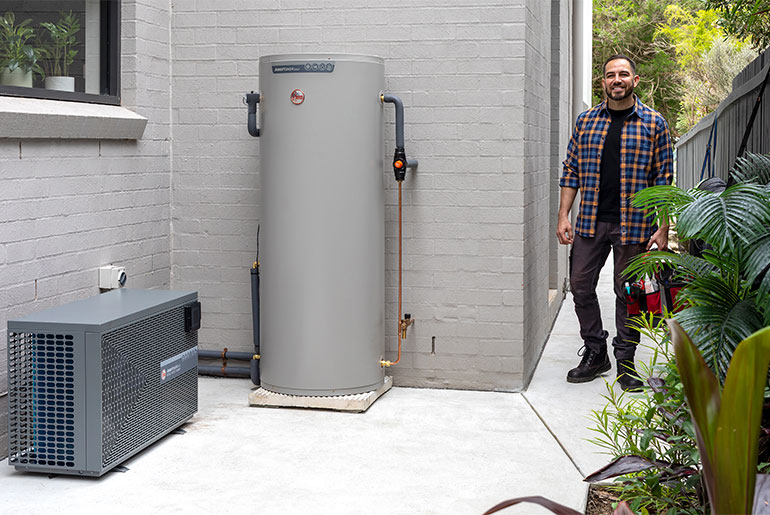
Heat pump water heaters are fast becoming the preferred hot water solution for new homes across Australia. They use the ambient heat in the surrounding air to heat water, offering homeowners an energy-efficient solution.
Why are heat pumps becoming the go-to option for new builds?
- They help meet energy-efficiency requirements and targets: Heat pumps provide a cost-effective option for builders seeking to achieve their National Construction Code ‘whole of house’ energy target.
- Reduced energy use: Homeowners can save up to 73% on their hot water energy usage compared to a similar size electric system depending on the location and the heat pump they install.1
- Supports Australia’s shift towards electrification: More Australians are moving away from technologies that use fossil fuels in favour of those that run on electricity.
- Efficient installation process for builders and plumbers: Modern heat pumps have similar plumbing and electrical connections compared to a traditional electric water heater.
- Add value to your builds: Potential buyers are increasingly seeking homes with energy-efficient features.
- Growing range of heat pumps: Rheem is home to a range of heat pumps suited to different household needs and hot water requirements.
In this article, we will explore these six benefits in a little more detail.
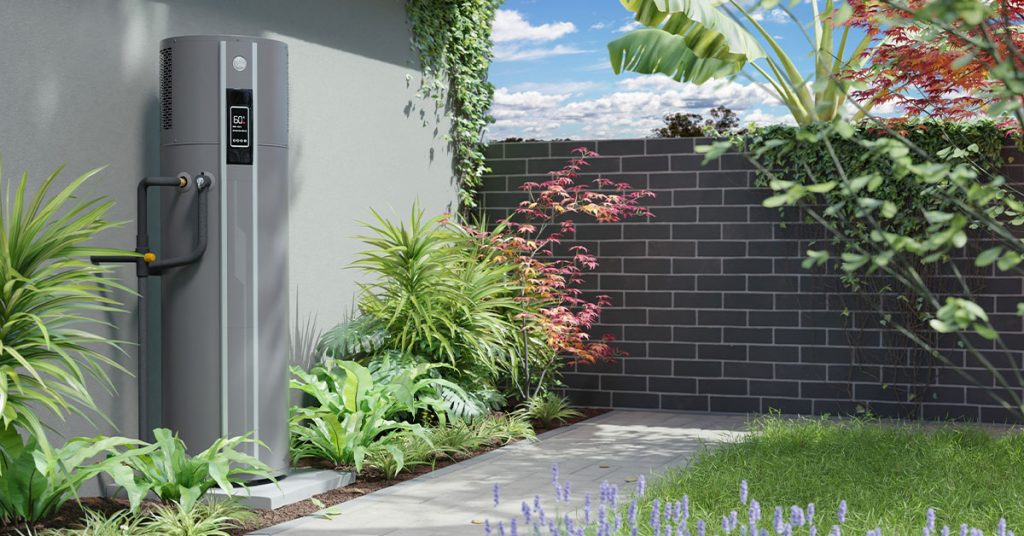
Six reasons why Heat Pumps make sense for builders
1. Meet the National Construction Code ‘whole of house’ energy target
With governments prioritising energy-efficient and environmentally friendly solutions, heat pumps offer a convenient solution that enables homeowners to reduce their carbon emissions.
Modern heat pumps have high Coefficient of Performance (COP). COP refers to the ratio of how much heat a system produces for water heating compared to the power input. For example, the Rheem AmbiPower 280e Heat Pump has an average COP of 5.2, meaning the system produces 5.2 times as much heat energy to the water as it consumes in electricity.2
Also, Rheem Heat Pumps use Low Global Warming Potential (GWP) refrigerants to reduce environmental impact.
By improving the home’s energy performance, heat pumps are a cost-effective option for builders seeking to meet their ‘whole of house’ energy target.
2. Reduce hot water energy use for homeowners
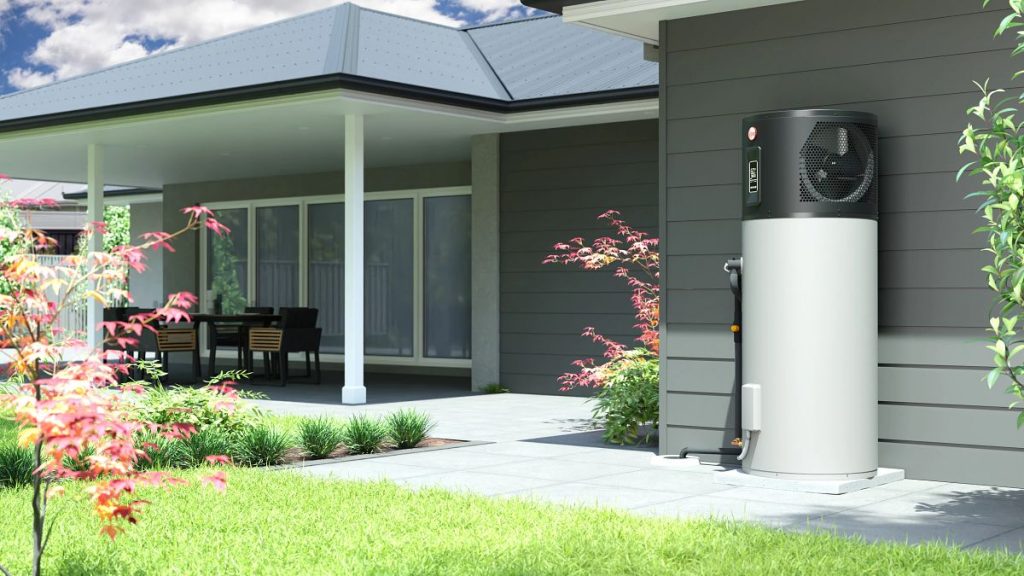
Because heat pumps work like an air conditioner on reverse cycle, it moves heat from the air to hot water rather than generating heat directly. Installing a Rheem Heat Pump could help homeowners save up to 73% on their hot water energy consumption compared to a similar-sized electric water heater. 1
Here is a guide on the possible water heating energy savings:
- Up to 70% with the Rheem AmbiPower® MDc-180 Heat Pump (180 litre capacity).
- Up to 73% with the Rheem Ambiheat® HDc-270 Heat Pump (270 litre capacity).
- Up to 73% with the Rheem AmbiPower® 280e Heat Pump (280 litre capacity).
- Up to 78% with the Rheem AmbiPower 5kW Split Heat Pump (available in either 315L vitreous enamel or 325L stainless steel tank).
3. Support Australia’s shift towards electrification
In Australia, electrification is gaining momentum due to government incentives, environmental benefits and cost of living pressures.
Hot water makes up about 25% of the average Australian home’s energy usage3, and heat pumps are playing a key role in Australia’s shift towards decarbonisation as they use a natural source – the air – to heat water.
4. Trade‑friendly installation with a 10A circuit Plug‑in option also available
Provided you plan for sufficient space outdoors for air circulation, installing a heat pump can be straightforward as they often use similar plumbing and electrical connections to a traditional electric water heater. Some models come with a Plug-in option using a 10A circuit, making it an easy electrical install.
5. ADD VALUE TO YOUR BUILDS
According to Domain’s Sustainability in Property Report 2025, energy efficiency is now a top priority for Australians. Some highlights from the report include:
- Homes with energy-efficient features sold for an average of $118,000 more than those without across Australia.
- Energy-efficient listings received 13.8% more views.
- Over half (52%) of homes sold had at least one energy-efficient feature.
6. Rheem heat pump range suited to a range of needs
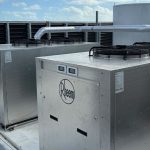
Rheem is home to a steady, hot and strong heat pump range, each suited to different household needs across different climate zones. This includes the Rheem AmbiPower 5kW Split Heat Pump:
- Great solution for homes with limited outdoor space.
- The tank can be installed indoors or up to five metres away from the split heat exchanger unit.
- Split heat exchanger is mountable up to 2 metres high on walls, making it ideal for narrow spaces.
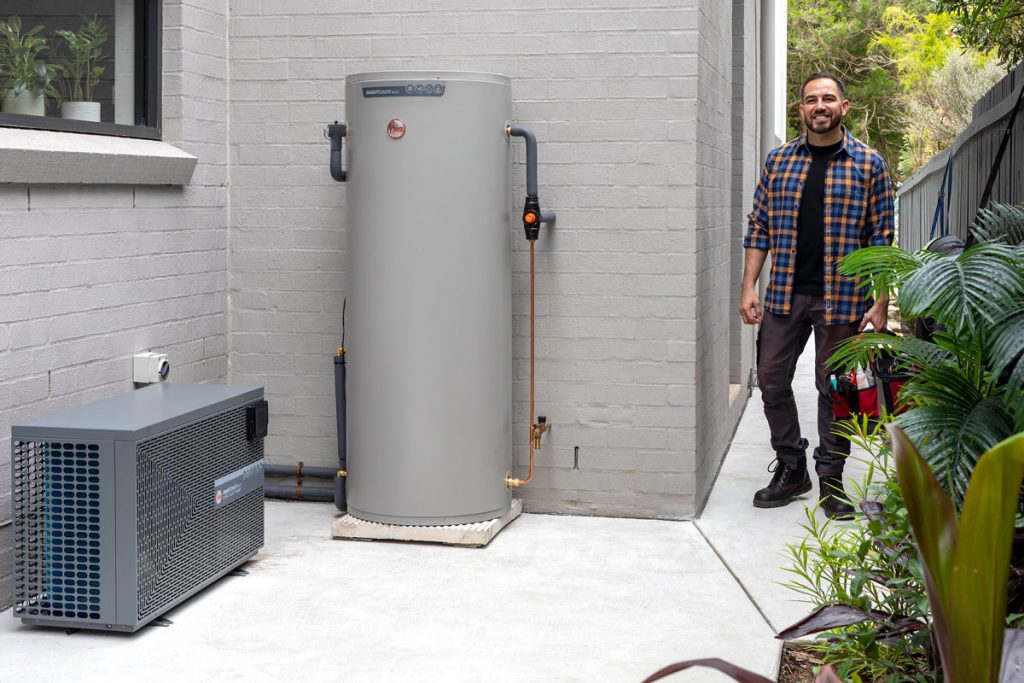
Also, Rheem recently launched the new Rheem AmbiPower® 280 Heat Pump in 2.4kW hardwired and 1.5kW Plug & Lead Wi-Fi enabled options. Powered by EcoNet™, the global Wi-Fi smartphone-based system is the integrated control for the home’s water heating.
Developed by Rheem, this solution provides optimised efficiency and control, giving the homeowner transparency on how their system is performing. Learn more here.
After more information?
If you’d like to know more about the benefits of heat pumps or the Rheem range, contact us today.
Disclaimers:
Note: New home builds are eligible for the Federal Government STCs program and can be claimed by the builder. Contact Rheem to find out how.
- Energy savings are based on Australian Government approved TRNSYS simulation modelling using a medium load in Zone 3 and apply when replacing a similar sized storage electric water heater. Any savings will vary depending upon your location, type of water heater being replaced, hot water consumption and fuel tariff. Any savings will vary depending upon your location, type of water heater being replaced, hot water consumption and fuel tariff.
- Average COP was measured under test conditions with an ambient air temperature of 19˚C/15˚C (Dry Bulb/Wet Bulb) and heating of the water from 15˚C to 60˚C during water heater operation. The average heating capacity of 4kW was measured under the same test conditions. The actual COP and heating capacity of the product at any given time will be impacted by a number of factors, including the ambient air and cold-water inlet temperatures at the place of installation and time of day / season of operation.
- Quick wins to save energy: Australian Department of Climate Change, Energy, the Environment and Water.

Comments are closed.